

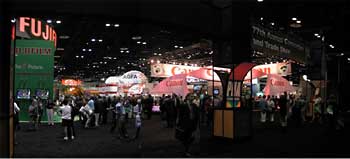
Home again and exactly 98.8 miles down the road from PMA 2001. If the Photo Marketing Association convention ever comes to your neighborhood, by all means go! My last PMA was in Chicago many years ago and how it's grown! At least 10,000 cameras, as many people, and twice the vehicles in the parking lot made the Orlando Convention Center a wonderful madhouse.
As usual, the widest and longest lenses were on show, as were the biggest and most expensive camera, and every one of next year's gadgets. But the most predominant word displayed was DIGITAL!
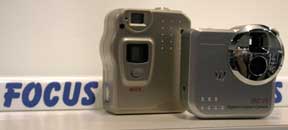
From Japan, Korea, Taiwan and China came the latest offerings to the digital camera world - my favorite was the tiny Focus (about $40 US if it ever makes it to these shores) with 2mb of DRAM memory and weighing about five ounces without batteries. Slightly bigger than a Zippo lighter.
Adobe Photoshop Elements
Adobe announced its replacement for Photoshop LE and for all practical purposes, PhotoDeluxe, and demonstrated Photoshop Elements, a $99 gee-whiz application that should give even the most timid of digital photographers heart palpitations.
Photoshop Elements lacks CMYK color space and some of the more sophisticated web editing features (slices, rollover) of Photoshop 6.0 but at first glance, it's equal to its big brother and has a whole bunch of new features. Adobe has abandoned the old cutesy graphical interface of PhotoDeluxe but made Elements more user-friendly with the addition of graphics.
For instance, booting up presents a Quick Start screen provides one-click navigation to any function (open, new, copy, acquire) with clear explanatory windows. These same windows are featured in the Hints palette, a sort of interactive help file that makes Tool Tips seems primitive. Combinations of effective techniques are explained and clickable in the Recipes palette.
Photoshop's filter menu has been transformed in Elements into a browser that shows a representative view of each filter effect. Pick the one you want, drag its icon onto your image and voila!
My favorite feature during Product Manager Mark Dahm's demonstration is Photomerge, which automatically resizes, skews and blends portions of multiple images into seamless panoramas. This crafty feature is worth the price alone.
Much more to come in a review in Photoshop User.
Electronic Film a reality - finally!
Emerging from the vaporous mists of rumor, Silicon Film Technologies demonstrated its Electronic Film System for the first time. (e)film is a 35mm-like cartridge with a protruding CMOS chip that adapts into conventional 35mm film cartridges. Currently developed for a select number of Nikon and Canon SLRs, the 1.3mp insert has a 64mb memory with each raw images requiring 2.6mb. Yep, that figures out to 24 exposures (per roll).
Part of the $699 package is the (e)port carrier which protects the cartridges and directly uploads images to a desktop computer. It also interfaces via a Type 2 PC Card port to laptops . A third part is the (e)port carrier which allows downloading the cartridge images to CompactFlash card without being tethered to a computer.
The demo was quite impressive under controlled studio shooting conditions. It was great to see this long-rumored product finally appear. Because the CMOS chip is smaller than a conventional 35mm frame, the effective focal length of lenses is multiplied by approximately 1.5.
The Big Guns
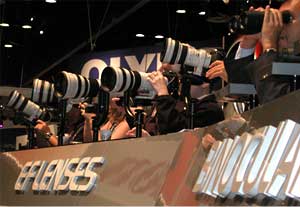
Mobs surrounded the booths where Canon exhibited its new EOS-D30 digital SLR. Nikon was also mobbed and while I was told its new D1X (5.75mp) was being shown but I was tired and footsore, not feeling like fighting my way through the crowd. Pentax was showing a pre-product 6mp SLR. Including the Fuji S1-Pro, the slate of digital interchangeable lens SLR's is filling up. All of these cameras share an image size/focal length factor, meaning the hot lenses right now are the super expensive ultra-wides (in the 14-15mm area).
One of the neatest parts of PMA is that every manufacturer brings its full array of products. So long, fast lenses affordable only by heads of state, were available to peer through, focus and compose.
The Big Guns (Kodak, Canon, Fuji, Nikon) has monster pavilions. Kodak is rumored to have spent a cool million on its PMA site. Kodak's pavilion squatted right in the center of the PMA trade show floor. A startling measure of the sheer size of the trade show was when the giant Kodak logo seemed to start vanishing over the horizon.
Grandson of MrSID
LizardTech gave a sneak preview of MrSID Generation 3 which will feature lossless compression incoding at ratios of up to 7:1. Most of the past emphasis on MrSID seems to have been on compression for Internet and wireless transmission, giving The Altamira Group a big publicity lead for lossless compression for printing. I was promised a review copy of MrSID3 when it's ready and it'll be interesting to see how it matches up with GF.
A Closer Look
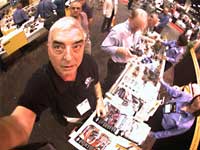
Many new prosumer digital cameras were offered. Sony produced a new line of Mavicas. Kyrocea showed a 3.3mp camera that could be a winner if it matches the hyperbole of its press release. Minolta introduced a new series which includes a pair of SLR-likes of the school of Olympus E10. The Dimage 7 has a 5.5mp CCD while the Dimage 5 offers a 3.4mp sensor. These pre-production units, when closed up, resemble the Fujifilm 4900 greatly.
More fascinating was the sea of smaller vendors, offering their products in highly specialized areas. One man gave me a sample of his company's odorless hypo, a great idea 10 years too late for this darkroom fugitive. The Hoodman brothers are coming out with Hoodskins, special optically coated protective membranes for LCDs. I got to chat with the designer and manufacturer of Pedco Ultrapods, the nifty tabletop tripods that can Velcro onto a tree or streetlight. I have mine for years.
In this pool of temptation, I stood strong. My only purchase was a $30 Mini-Slave Wide strobe, a bare bulb light to use with my Nikon CP990 - something I've been search for years. Even though the girl at the Nikon CoolPix desk offered me a good deal, I resisted the urge to pick up a Fisheye lens.
 Jim
Patterson was a respected, trusted resource for anything
to do with digital imaging and a regular digital photo
columnist for Mac Design Magazine and contributor to
Photoshop User magazine. He passed away the summer of
2004. Jim was frequently-published as a freelance travel
photojournalist, and authored the novel, "The Thirteen." There
was much more to Jim than just a writer, and he was much
more to us than just a friend.
Jim
Patterson was a respected, trusted resource for anything
to do with digital imaging and a regular digital photo
columnist for Mac Design Magazine and contributor to
Photoshop User magazine. He passed away the summer of
2004. Jim was frequently-published as a freelance travel
photojournalist, and authored the novel, "The Thirteen." There
was much more to Jim than just a writer, and he was much
more to us than just a friend.
