

A type face may be named for its original designer (Baskerville, Bodoni, Garamond, Goudy); for its use (Times Roman was designed for the London Times ; Century and Avant Garde were designed for Century and Avant Garde magazines); for its characteristics (Excelsior and Paragon were designed for high legibility); or for its designer's fancy (Perpetua, Souvenir, Centaur).
Type faces are also given generic names as well as brand names, e.g. different type-founder's call Times Roman different names, e.g. Times New Roman, Geneva, and English. Type founders' versions of the same type face differ only slightly from each other. Even so you can, for example, seldom interchange one type founder's 10-pt Baskerville with another's, to try to do so would result in a noticeable mis-match with the original setting.
To identify type or recognize a wrong font, you must know what the variables are, because differences amongst the thousands of type faces available today can be minute. Since an untrained eye cannot distinguish even gross differences, you should become familiar with the fundamental features of type that are labeled in the following diagram:
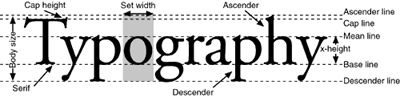
Basic Anatomy of Type
x-height The height of the lower case letters such as 'x', 'a', 'e'.
Ascender The stroke of a letter which rises above the Mean line as 'k', 'l',
'h'.
Descender The stroke of a letter which hangs below the Base line such as 'p',
'y', 'g'.
Mean line The imaginary line which determines the height of lowercase letters;
ascenders rise above the mean line.
Base line The imaginary line on which all characters rest; descenders hang
below the base line.
Body size Size of the type being used; measured from the end of the ascender
to the end of the descender.
Serif Small strokes and cross-lines at the ends of major lines.
Set width Width, in units, allowed for each letter which varies between letters
and type faces.
Cap Line The height of capital letters. Depending on type design, capitals
may be taller/shorter or same height as ascenders.
Type Categories
All type faces that are to be used in the appropriate print media must be purchased under a number
of specific criteria. It is important to know whether a favored type design has the necessary flexibility
to be used for a wide range of design and publication needs.
To this end, you must be aware that not all type faces that are used have the same number of variations,
or for that matter are available on the output device that you wish to use.
Font
Many of the more popular type faces used today are available in three different alternatives: Commercial
font , Expert font and Pi font .
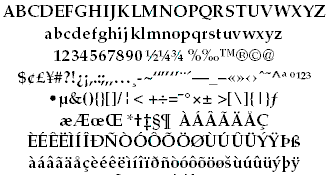
A Commercial type font contains the usual range of characters that are needed for most forms
of typesetting, i.e. one complete assortment of alphabet letters comprised of capitals and lower case,
numerals, punctuation, special characters, and symbols.
A type font is only available in one specific type face design. Therefore, a type face such as 10-pt
Times Roman is considered to be one font and 10-pt Times Bold is another .
Commercial font
Purchasing the same font from two different type foundries may yield the addition or deletion of certain
special characters.
In Desktop Publishing, extra care must be taken when working across two or more platforms because certain
characters from the same font and type foundry , accessible on the PC platform, are not available
to the AppleMac.
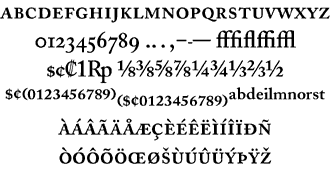
Currently, Expert fonts are limited to those fonts which are the most popular type faces. These
fonts contain special characters such as 'ligatures', 'small caps' and 'swash' letters that are not
normally used, or needed, in the everyday world of commercial typesetting. For certain classes of bookwork
and high-class typesetting purposes, their inclusion forms an invaluable addition to the finished result.
Expert Font
Swash Font

Alternate Character Font

Swash Character Font
It is unfortunate that in many cases, the actual number of characters that typefounderies include into
some of their expert fonts is small, necessitating the purchase of additional fonts to service particular
typesetting needs.
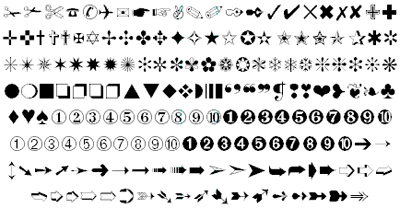
Pi fonts usually contain a collection of special characters such as mathematical, monetary or
decorative symbols, etc.
Pi Font - Zapf Dingbats
If you have a special need for certain characters, most manufacturers will make a pi font to fit your
need using standard characters or even develop new one to suit you. Symbol , Carta ,
and Zapf Dingbats are examples of common pi fonts.
Family
The last variable in the flexibility (and popularity) of a type face design is whether or not the design
has a range of variants. If a number of fonts have the same name and general characteristics of face,
e.g. Times Roman, Times Bold, Times Roman Italic, etc. then they are known as a Family .
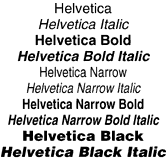
Font Family
The majority of fonts in common use have at least four variants, i.e. normal, italic, bold, and bold
italic. The popular type design used above (Helvetica), has a family of over 50 variants, whereas many
decorative and script style fonts such as Algerian, Arnold Boecklin Giddyup and Pepita, do not have
a range of different variations and are usually restricted to a single font.
When nominating a type face, the order of description can be thus:
Type Size: 10 point
Type Body: 12 point
Type Family: Helvetica
Type Weight: Bold
Type Width: Extended
Type Modification: Outline
Type Posture: Italic
An important factor in the composition a piece of design is the selection of the correct type faces.
Choosing the right type face makes clear the sense of the message, and imparts that atmosphere or environment
which enables it to be more easily understood.
The number of type faces in use today runs into the thousands and as such presents difficulty in selecting
the appropriate design for a particular job. Because there are so many type designs to choose from,
it is easier to first choose a general type style or classification to suit your design, and
then, look for a particular type face that relates to that classification.
Although there are well over 32 unique type classifications, the simplest form, as follows, places
type into seven broad classifications:
Roman (Serif)
Serif is an all-inclusive term for characters that have a line crossing the free end of a stroke. This
style face, said to have been invented by the Romans, is also commonly referred to as 'roman'. It is
the one most often used and also one of the most legible styles. The style is very comfortable and
familiar to all readers and is therefore used in the bulk of reading material.
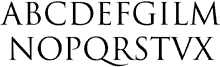
'Tranjan Letter' shapes based on ancient Roman lettering
The Serif type face is then further classified into Humanist, Garalde, Transitional and Didone, according
to their stress and serif-form as follows:
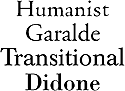
Humanist Faces:
Stemple Schneidler, Centaur, Italia, ITC Berkeley
Garalde Faces:
Bembo, Garamond, Plantin.
Transitional Faces:
Times New Roman, Lucida, Baskerville.
Didone Faces:
Bodoni, Walbaum, Americana.
Humanist (Venetian)
faces are named after The first roman type faces that appeared in Venice in 1470, Humanist type faces
were initially designed to imitate the handwriting of Italian Renaissance scholars. These types that
are characterized by their strong, bracketed serifs. The letters are in general wide and heavy in colour.
Other characteristic letters are the wide lower case e with a diagonal bar to the eye. A noticeable
feature of true Humanist types is the square full point.
These types have a small x-height, moderate contrast between strokes, and an acute 'angle of stress'.
Garalde (Old Style)
were designed centuries ago by such masters as the French printer Claude Garamond and the Venetian
printer Aldus Manutius. Garalde type faces include some of the most popular roman styles in use today.
These faces have rounded serifs and moderate contrast between strokes. The letters are open, rounded
and very readable. The thick strokes of curved letters are off-balanced. The 'angle of stress' of these
types is less acute than Humanist types.
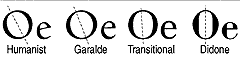
'Angle of stress'
Transitional faces reflect the fact that the eighteenth century was a time
of transition. During this period, type designers were more likely than their predecessors to rely
on mathematical or scientific principles to create new letterforms.
Containing elements of both Garalde and Didone styles, these faces have rounded serifs which are less
formal than Didone, but more formal than Garalde and therefore reflect the transition from Garalde
and Didone.
Curved letters are more balanced than Garalde and the 'angle of stress' is near vertical to the Didone.
Didone (Modern) faces typify the profound affect the course of typography would
take as a result of improvements in paper production, composition, printing and binding during the
late eighteenth century. It was possible to develop a type style with strong vertical emphasis and
fine hairlines; this is what the French family Didot did, and what the Italian printer Giambattista
Bodoni perfected. This style has thin, straight serifs, with an extreme contrast between the thick
and thin strokes; curved letters are balanced and slightly compressed. The 'angle of stress' is vertical.
Italic
The upper and lower case roman alphabet acquired, since they were first used, an italic and bold companion
letter. It was a different alphabet closer to handwriting than the roman, and was based on the handwritten
script of the day. Designed centuries ago, it was the Venetian printer Aldus Manutius's designer, Francesco
Griffo who not only refined the roman letter but also cut the first italic type face. As such, like
the word 'roman' the word 'italic' credits Italy as the land of origin. It was coined by the French
and was not capitalized.
Today, italics may be based on serif, sans serif or slab serif types. While the slant of the italic
will vary, a good standard is about 78º.
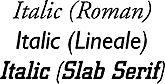
There are three kinds of italics:
Unrelated italics are 'pure' styles based on 15th-century 'hands'.
Related italics are designed to blend with a specific roman type face, but
still more or less 'pure' italic.
Matching italics are essentially the same design as a particular roman type
face. Digitized typesetting devices that modify characters electronically to create italic are creating
matching italics, although purists will call them 'oblique'.
Italic differs from Script in that the letters never join nor do they appear to join. They have a free
flowing appearance creating daintiness, charm or action which makes them ideal for gaining attention
in text or headings.
Today it is used for emphasis, titles, quotes and extracts. Italic is not as legible as roman when
used as paragraph matter and is therefore not recommended for large areas of setting. All capital italic
lines are to be avoided.
Lineale (Sans Serif)
Though the first sans serif ( sans meaning without ) type face was issued in 1816, another
hundred years passed before this style gained popularity. Then, in the 1920s, when typography was heavily
influenced by the 'less is more' philosophy of German's 'Bauhaus' school of design, designers began
creating type faces without serifs.
A popular type face for all classes of publicity and advertising work due to the large variety of weight
and styles available and because their structure suggests newness and attention-awakening appeal to
a remarkable degree. They possess simplicity and neatness since there is little variation in the thickness
and weight of the letter strokes.

One of the main causes of the popularity of the sans serif in display work is because of the ease with
which the thickness of the strokes can be increased and the design of the letters expanded or condensed.
These modifications are much easier to perform than with serifed types. However, because of the absence
of serifs, they are not recommended for large areas of solid text setting but can be used for headlines
without any problems.
Slab Serif
The Industrial Revolution of the early nineteenth century encouraged the development of very bold printing
types that could be used for a new vehicle of communication: advertising, posters, flyers and broadsides,
which all completed for attention. They were often created using slab serif type faces, which, with
their strong, square finishing strokes, proved very effective for commanding readers' attention.
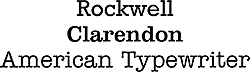
There are actually three kinds of Slab Serif types faces: slab serifs, Clarendons, and typewriter types.
While the stems and serifs of all three kinds often appear to have the same stroke of Type thickness,
slab serifs have a square, unbracketed serif, Clarendons have a square, bracketed serif, and typewriter
types have similar weights of stems and serifs together with a constant character width.
Today, these styles are still popular with advertising agencies in the production of advertisements
and other publicity work. Although of a hybrid combination of Sans Serif and Roman, they are not truly
suited to large areas of solid setting.
Slab serifs only appear to advantage when used as a series or family in any piece of display, therefore
they should not be combined with any other kind of face.
Text (Blackletter)
This style of type mimicked contemporary manuscript handwriting which was drawn with a wide, flat pen
popular in much of Europe at Gutenberg's time. You may also hear it referred to as Old English, Gothic,
or Blackletter.
Although this style is still used extensively in certain European countries, we in the English-speaking
world find the structure of the letters complex and therefore difficult to read in paragraph form.
For this reason, text should seldom be used in small sizes.
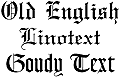
Text type faces should fit snugly together with less space between the words than is customary with normal Roman types and, because of their complex structure, should never be set in all-capital form.
These letters are used for formal occasions such as diplomas and invitations. They establish a feeling of a monumental event and are sometimes used for ads and books where the subject is history or antiquity.
Script
Since a Parisian printer created the first in 1643, script type faces have become almost as numerous
as the handwriting instruments - brush, broad-edged pen or pointed pen - that they were designed to
imitate. All script faces are based on different styles of cursive or current handwriting and is frequently
ornamented with flourishes. Letters of this form are usually highly rounded, slant to the right, and
either connect from letter to letter or have a tail on the letters which leads to the next.
Scripts are available in two broad styles:
Formal script is usually characterized by having a small x-height and long
ascenders and descenders in imitation of the classical pen handwriting. This style is used extensively
for formal type printing and invitations.
Informal script is more suited to work of a less formal nature: menus, advertisements,
etc. and is characterized by the looser, less restrained formation of characters. The letters appear
to have been casually drawn by either a pen or brush.
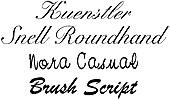
Because these types imitate handwriting, two of the main essentials when using Script are not to have too much space between the words and to take additional care when considering leading.
Decorative
These type faces are also known as novelty faces and are primarily designed to be used for a word or
words in display or headings and as such are not suited to text setting.
One kind of decorative type face seeks to create a mood and is therefore highly emotive, another kind
is designed to represent something else: computer printouts, baseball bats, balloons, etc. The majority
of these types are designed as a single font only with perhaps only a handful containing a small family
such as normal, bold and outline.
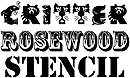
The specific nature of the designs of these types are such that most must be separately purchased. Alternatively, boutique type design houses offer decorative faces far above and beyond those which are offered by major type foundries such as Adobe, Linotype, Monotype and Bitstream.
