

There will never be a "universal design language". With every tutorial that we offer, I seem to get at least one email asking, "Why did you do it that way?" Well, simply because that is the way that seems easiest to me. Under the same vein, you will no doubt find a variety of ways to create Pill-Shape buttons in Photoshop. This is the method I use because it's simple and produces great results. Shall we dig in?
1. Open a new canvas at 300 x 150 pixels, 72 pixels/inch.
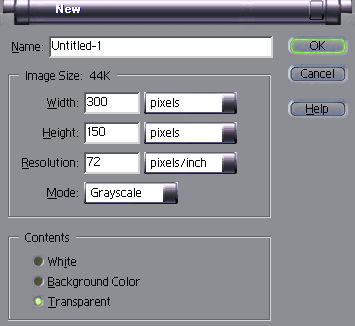
2. Double-check to see that you're in RGB mode, then fill the canvas with the color of your choice.
3. Make a new layer (click Layer > New Layer).
4. Click on the marquee tool, and enter the marquee options. You need to have this set to a fixed size of 75 x 75 pixels.
5. Make sure that your marquee is eliptical (right-click the button and choose the circle), and click anywhere on the canvas. Move the circle just in from the left edge and middle of the canvas.
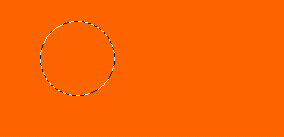
6. Fill the circle with a medium value color. Which color doesn't really matter at this point, we're going to change it in a moment.
7. Click View and hover over Show rulers. Before you click on Show Rulers, make sure that "snap to guides" is checked. Then click the "Show Rulers" option.
8. Move your cursor to the top ruler. You will see the cursor become an arrow. Hold down your left mouse button and drag. As you do this, your cursor changes with a line going across your canvas. Drag this down to the bottom of the circle, and release the mouse button. When you're done with this step, you can hide your ruler (View > hide rulers) if you don't like them.
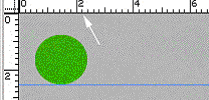
9. Zoom in on your canvas, to help with accuracy.
10. Select the rectangular marquee (right click the marquee button and choose the square). Make sure your options are still set to fixed at 75 x 75 pixels. Click on the canvas and move the square into position - the top corners of the square should just barely touch the circle.
11. Now, hold down Ctrl + Alt keys TOGETHER (don't release them until your final shape is completed) and hold down the right arrow on your keypad. Release the arrow key after a second or two, and the shape should begin to show. If nothing happens, hold the arrow key until it works. Let go of all your keys. What you want to happen is for the shape to nudge into an oblong ... thing.
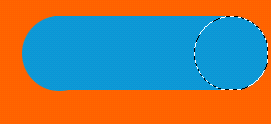
12. Deselect by clicking off the canvas, and resize your image back to the original (zoom out). You can also hide your guides (View, hide guides).
13. Now, we get to change the colors into something more "artistic". Set your foreground color to something light (within the shade that you want your button to be) and your background to a darker shade. Use the magic wand to select the outline of your button.
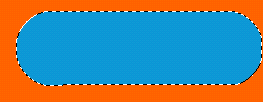
14. Select your gradient tool. Run a gradient line from the top center to the bottom center of your button. You may have to re-gradient a couple of times to get the fade you like, but will end up with something similar to what I have below.

15. I usually run the blur tool over the edges, carefully, so that there aren't any jagged lines. Then copy-paste it to a canvas with a transparent background (or your web page background color) and save.

So that's the pill-shaped button... What else can we do with it? Read on to change the "look".

The pill-shaped button by itself is pretty cool. But I've never learned to leave good enough alone. So now let's make it even cooler.
16. Make a mouse-over effect of a "depressable button". First, select the whole button. I usually hold the Shift key while I hit the gradient shades with the magic wand.

17. Click the "Select" button in your toolbar. From the menu click Modify, then click Contract and enter 6.
18. Again, click the "Select" button, and choose "Feather", enter 2.
19. Now, click "Edit", and choose Transform, Rotate by 180.

You can now save this "depressed" button as your mouse-over image! But don't deselect yet, there's still more we can do.
To create an "inset" or "border button", follow the next steps from where you're at.
20. With the inner portion of the button still selected, click "Select", choose Modify and Contract, enter 4.
21. Click "Select" and choose Feater, enter 1.
22. Click "Edit", and choose Transform, Rotate by 180.
23. Deselect it, and you should have a button like this:

Three buttons for the price of one ;-). There's still more that you could do with this, including the many text effects (engraved, maybe?) that you can create. Just experiment - with the foundation, you are limited only by your imagination.
