


If you have a website, it needs to grab attention. You
have to catch a visitor's interest and make him or her want to delve
into your site. Otherwise, the site won't do you much good, no matter
how much traffic you're getting.
If visitors land on a page that is visually uninteresting,
you will fail to capture their attention. If everything on your pages
receives the same amount of visual importance, visitors are likely to
be bored and unfocused.
So how do you make your site stand out visually? Employ the principle of contrast. The principle goes like this:
To create strong visual impact in your pages, make some things stand out. Big time.
Add variation by visually emphasizing differences between
items. If two elements don't look the same, make them look really
different. If something is important, give it extra visual weight.
Contrast works by creating sharp distinction between two
items. The end result is to emphasize one item over the other, which
makes that item stand out. This adds interest to your pages. It also
helps organize and prioritize elements, and it focuses visitors in the
specific direction you want them to go.
When you use the principle in your website, visitors are
immediately drawn to the item that has the most contrast from
everything else. By using contrast, you can keep your visitors from
getting distracted and wandering all over the page. You'll be able to
keep them tuned to the most important things.
If your pages don't use strong contrasts, they will appear
dull and uninteresting. A page that doesn't have distinctions between
elements lacks focus, because there is no clear place for the eye to
stop. It's much harder for visitors to get excited about a page that
looks boring than a page where certain elements leap out and capture
interest.
How can you use contrasts? Here are a few ways:
1. Color
Color is a powerful way to establish the importance of one
element over another. If you need something on a page to stand out,
infuse it with some vibrant color. Usually, you should make it a
brighter or stronger color than everything around it. You can do this
by changing the color of the text, by placing a colored background
behind the element you want to emphasize, or using a brightly-colored
image or button.
Using contrasts in color doesn't always mean you need to use
bright or "loud" colors. If the rest of your page uses subdued colors,
even a gentle color contrast may be sufficient.
2. Size
If you're going to make a contrast in size, make a serious
contrast. Most people do not make size differences significant enough.
Failure to make a strong distinction results in a page that looks
cluttered and messy.
The most common place to use size contrasts is in text. For
example, when you make a heading bigger than your body copy, you've
used a size contrast. However, you can also contrast size with other
items. If you have a variety of pictures on a page, you can make one
significantly bigger.
3. Direction
You can create contrast by varying the direction (horizontally
and vertically) of elements in a page. This contrast is more subtle and
not quite as common as color and size.
Contrasting direction doesn't necessarily mean to turn a word
on its side so it is pointing upward. You could do that, but there are
other ways that don't impede readability. You can contrast a long
horizontal header that spans the page with two tall, narrower columns
of pictures or copy underneath it. You can contrast a thin vertical
column of text with horizontal rules (dividing lines) to separate
different parts.
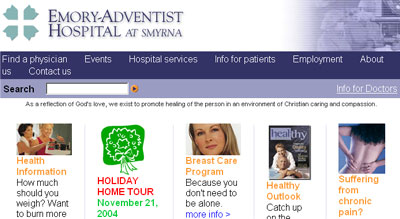
For example, take a look at Emoryadventist.org.
Notice that the header at the top is wide and the four columns of text
are narrow and are divided by vertical lines. The page would be much
less interesting if everything on the page had a horizontal direction.
Finally, two important reminders on using contrast:
First, if you emphasize everything, nothing stands out. Be
careful not to use so much contrast that your page is overpowering or
cluttered. Contrast has to be used wisely in order to be effective.
Second, don't be a wimp. If your contrasts are too mundane, you'll appear dull and uninteresting. Be daring!
 |
 |
|

