Her
Home
HTML and CSS
Tutorials
The basics of html
The basics of html
Author: Selena Sol
Author's URL: extropia.com
More by this author
The History of the Web
- The web was initially conceived and created by Tim Berners-Lee, a computer
specialist from the European Particle Physics Laboratory (CERN) in 1989.
- In his words, there was "a need for a collaborative knowledge-sharing tool" to
support scientific work in an international context.
- He and his partner Robert Cailliau created a prototype web for CERN and
released it to the Internet community for testing and comments.
The web is not synonymous with the internet, though some people may think
so. Actually, the web is one way to utilize the infrastructure of the internet.
In other words, the web is a subset of the internet.
- Since then it has grown into the web we know today under the guidance of
the World Wide Web Consortium (W3C) that is a volunteer organization based
at the Massachusetts Institute of Technology (MIT) with the responsibility
for developing and maintaining common standards.
- Perhaps the single most important technological development in the history
of the web, besides the creation of the web itself, was the development of
graphical browsers in the early 90s. Beginning with NCSA's Mosaic and its
evolution into Netscape's Navigator and Microsoft's Internet Explorer, these
programs allowed users to browse the resources on the web in an extremely
user friendly environment. This made the web a "fun" place and marked the
beginning of the true web revolution.
The Nuts and Bolts of the Web
- So what exactly is the web?
- The web is a complex, international, cross platform, cross language, cross
cultural mesh of servers, clients, users, databases, and quite a few artificial
intelligences all talking, working, searching, viewing, accessing, downloading,
and who knows what else.
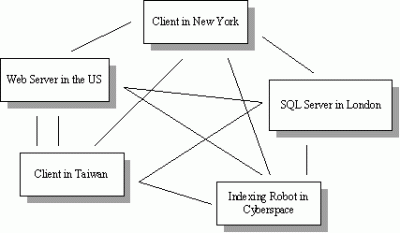
- As such, no one owns or controls the web. In fact, it is impossible to
own or control by its very nature and design. In fact, "it" is not even an "it".
You can't hold the web or make it tangible. Instead, you can think of the
web not as a thing, but as a process, an action, a medium of communication.
- This fact has profound implications on how you should think
about designing web pages. For example, give up any hopes
of maintaining intellectual property over what you distribute on the
web and know that the only information that is private or secure is the
information that is stored solely in your own neurons.
"The Internet" is quite a different thing from "an Intranet". An Intranet is
a mini web that is limited to the users, machines, and software programs of
a specific organization, usually a company. Since organizations are typically
small and have more control over policies and information systems, intranets
are often more controllable.
- So how do all these computers, software packages, and people communicate
with each other?
- The creators of the web devised standards of communication upon which the
web is built. These standards sit at a layer above operating systems, computer
languages, or internet transmission protocols and provide a basic medium
for communication.
- The two most important standards (protocols) used on the web today are
HTTP and HTML. Let's look at each of those protocols more in depth...
The Basics of HTTP
- As Hethmon notes in " An Illustrated Guide to HTTP , "the web is the largest
client/server system implemented to date." It is also the most complex and
heterogeneous one that must deal with multitudes of operating systems, human
languages, programming languages, software, hardware, and middleware.
- What is a client/server system?
- A client/server system is a very keen way of distributing information across
information systems like a local area network (LAN), a wide area network
(WAN), or the Internet.
- A client/server system works something like this: A big hunk of computer
(called a server) sits in some office somewhere with a bunch of files that
people might want access to. This computer runs a software package (uh...also
called a server unfortunately) that listens all day long to requests over
the wires.
The "wires" is possibly a twisted pair network hooked into a local telephone
company POP or a cable or fiber optics network hooked up to a corporate WAN
or LAN that is also linked up to the national telecommunications/information
infrastructure through a local telephone company. Whatever the case, the
specifics of the information infrastructure is beyond the scope of this tutorial,
but should be mentioned.
- Typically, these requests will be in some language and some format tha
the computer understands, but in English sound something like, "hello software
package running on a big hunk of computer, please give me the file called "mydocument.txt" that
is located in the directory "/usr/people/myname".
- The "server software" will then access the server hardware, find the requested
file, send it back over the wires to the "client" who requested it, and then
wait for another request from the same or another client.
- Usually, the "client" is actually a software program, like Netscape Navigator,
that is being operated by a person who is the one who really wants to see
the file. The client software however, deals with all the underlying client/server
protocol stuff and then displays the document (that usually means interpreting
HTML, but we'll get there in just a bit) to the human user.
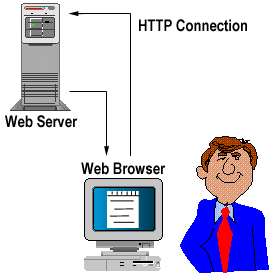
- The whole process looks something like the figure below:
- So if the web is a huge client/server system, what is the underlying client/server
protocol that is used by the client software and the server software for
communication?
- Well the client/server protocol used by the web is HTTP (HyperText Transport
Protocol).
- HTTP is a protocol that is defined in several RFC´s (Request for
Comments) located at the Internic and has had several generations worth of
revisions (HTTP/09, HTTP/1.0 and HTTP/1.1).
- HTTP is a "request-response" type protocol that specifies that a client
will open a connection to a server then send a request using a very specific
format. The server will then respond and close the connection.
- The details of HTTP are less important for an HTML designer as they are
to a web programmer, so we will not go into the specifics here (although
they are available from the Illustrated Guide to HTTP referenced in the Resources
section below). The main thing you need to know is that HTTP is a language
spoken between your web browser (client software) and a web server (server
software) so that they can communicate with each other and exchange files.
- As a web designer, you will deal much more with the other web protocol,
HTML that is discussed next.

