Step 1
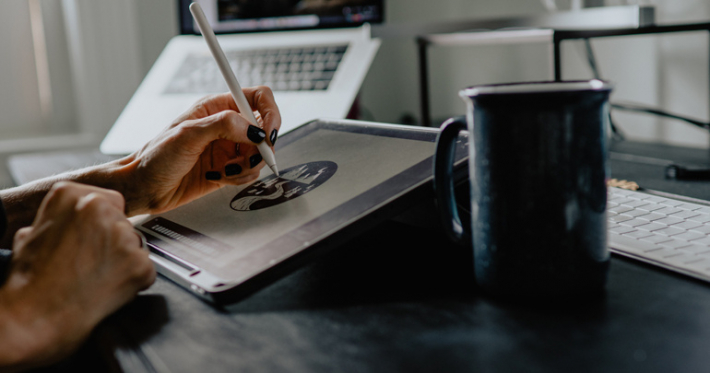
Before sketching your
character on paper with a pencil, you need to decide what it will be
(human? dog? flower? suitcase?) and think about its personality and the
feeling of your piece. Is it to be heartwarming, intelligent, or
violent? Keep experimenting with
your sketches to find the perfect design. Try different ways of drawing
facial features and body shapes.

Step 2
It's also worth giving it a
purpose. Is it to be informative or entertaining? What will it bring
to the viewer? You may want to add props to strengthen its integrity or
charm. In this tutorial, we're going to be working with Sanchez, an
office boy/flower that tells us all to spend less time in the office
and more time outside.

Step 3
Now, sketch its environment - where does your character live, and what is your illustration as a whole going to depict? Ensure the illustration style of your landscape and character work together, even if they differ slightly. Try and keep your sketch fairly clean, it will help when you come to tracing in Illustrator.

Step 4
Once drawn, scan it in. If
possible, scan at a high-resolution (300dpi is recommended) as you may
need to zoom right into the sketch to trace smaller details later, and
save your scan as a JPG and import it onto your artboard in Illustrator
(File>Place). To help with this tutorial, the original scan is
included on the cover CD.

Step 5
Next, we're going to trace
the sketch. Ensure you retain the natural curves you put into the
sketch. Relying too much on the bezier curves created within
Illustrator can make your character look too plain or unnatural, being
made up of regular graphic shapes. It's worth spending time over the
tracing, as it can be tricky going back to this stage once the image
starts coming together as a whole.

Step 6
Illustrator has three
brilliant tracing tools, especially if you are using a Wacom tablet and
pen; the pencil retains a very natural line, although it can be a
little shaky. The paintbrush allows varied line thicknesses and can
work wonderfully for a fresh adaptation of the traditional tool. The
pen tool is incredibly clean but the bezier curve function can take
some time to get used to.


Step 7
Where
possible, group your objects according to what colour they will be
later, allowing you to colour them all at once and try colours more
easily without having to go through and select each object individually.
Select the objects using the direct selection tool, then group using
Cmd/Ctrl+G. For example, if you have a field full of same-coloured
trees, group them together in the layers panel.

Step 8
Illustrator has some
wonderful colour swatches (Window>Swatch Libraries) some of which
are particularly formatted for print processes, for example Pantone
Solid Uncoated which is solid (neither pastel nor metallic) colours to
be used on uncoated print stock, such as art prints on watercolour or
textured paper. It can be a bonus to always use Pantone swatches so you
can easily get the Pantone codes if required by a printer or your
client.


Step 9
Don't just choose colours
that look nice. Pick colours that set the scene, create an atmosphere,
depict a time of day and add depth to the scene as a whole. Here we are
going for an airy, spring afternoon. Also, don't be afraid to
experiment with the outlines, either colouring them, or taking them
out. Landscapes without outlines have a more authentic air to them.

Step 10
When colouring your
character, really take your time to get it perfect. Consider whether or
not the colouring could confuse the viewer (colouring a zebra in two
tones of brown may just make it look like a horse, for example). Colour
the predominant areas of the character first, then colour the smaller
areas and props to complement.

Step 11
Illustrator has some wonderful
graphic tools, so make use of them. The star tool can add a kitsch
effect. Click on the Rectangle tool and scroll along to the star, then
click on the artboard and enter the values required. Colour gradients
always add a satisfying depth, and you can also break your faded
gradient into tonal bands (select the object with the gradient, then
click Object>Expand and decide how many bands of tone you require).

Step 12
Look at your masterpiece
as a whole, and to ensure the character fits comfortably into the
scene, consider adding a shadow. Use the pen tool to draw the shape
then select a darker tone of the colour you have on the ground, and
reduce the opacity (Window>Transparency) to suit.

Step 13
If you are keeping the
outlines on your illustration, make sure they are all correct and of a
balanced thicknesses throughout. Thick lines in the distance can make a
scene look incredibly clumsy. If you have text, whether it's a title,
tagline, or in a speech bubble, take some time to choose a font that
suits your character's personality and the style of the scene. If you
continue to use your character, the font may be a useful branding tool
for future creations.

Step 14
Don't just choose colours that
With your character's first illustration complete, consider taking
him/her to other places, locations and situations, build on its life
story and personality. Taking your character to different landscapes
can improve your skills having to evoke different types of scene but
each being part of a series in the same style. Or you could take your
character into other media...

Step 15
T-shirts are always a
popular medium for fresh design and illustration work. Our design will
have to use a limited number of colours - most T-shirt printers ask for
four colours or less. Consider adding slogans or different graphics to
your previous landscape image. Think what works well on T-shirts, and
what products would you buy yourself? Many T-shirt printers also make
belts, bags, pin badges, and other products.

Step 16
To get your artworks out
into the world you could sell them as art prints (giclee prints are
cost effective and high-quality), postcards or stickers (both can be
great promotional tools and are available from many online suppliers).
Try and include your URL or contact details - you never know who may
see your character.
I'm a Web-Graphic Designer, Freelance and Webmaster, blogger and more. I like to push the boundaries. I love creating unique, clean, usable design for the web and other digital sources.